Title: Estrogen Regulation of Growth Hormone Action
^^^^ Much better read. Strangely, also gratis.
"Kelly et al. (122) compared the effects of three different oral formulations (ethinyl estradiol 20 μg, conjugated equine estrogen 1.25 mg, and estradiol valerate 2 mg). All three estrogen formulations induced a significant fall in LH and FSH, in parallel with reciprocal elevations of SHBG and angiotensinogen. GHBP rose in parallel with these hepatic proteins. Each of the three estrogen formulations significantly reduced IGF-I levels and increased mean 24-h GH and GHBP concentrations (Fig. 2). The increase in mean 24-h GH concentrations during treatment was significantly and inversely related to the percentage fall in IGF-I levels. This inverse order of effect induced by the three estrogen types provides further support that the stimulation of GH secretion arises from reduced feedback inhibition by IGF-I. The increase in GHBP in response to oral but not transdermal estrogen indicates GHBP to be an estrogen-sensitive hepatic protein similar to SHBG and angiotensinogen (106).
The qualitatively similar responses displayed by all three [oral] estrogen formulations indicate that the reduction in IGF-I levels is an intrinsic effect of oral administration on the liver regardless of type (122). If this is true, elevation of estrogen in the systemic circulation to sufficiently high levels should induce a similar effect on hepatic function. Indeed, Friend et al. (123) observed that circulating IGF-I levels in postmenopausal women fell when transdermal patches were administered at seven times the therapeutic dose and that this was accompanied by an increase in GH concentrations, changes indistinguishable from those achieved by oral administration of 2 mg 17β-estradiol. Taken together, the results indicate that it is the high estrogen concentration that impairs hepatic IGF-I synthesis regardless of how this is achieved via the portal or systemic circulation."
Ergo, low dose oral raises your GH and drops your IGF (the rise in GH is negative feedback of lower IGF, and lower IGF is a product of oral E liver stimulation, via GHBP increase and GHR understimulation).
The same problemmatic effect is achieved by high E2 levels from transdermal/parenteral, but not by non-oral methods of administration that produce equivalent to problemmatic oral E2 plasma levels but bypass first pass (relatively low levels).
Another con for high parenteral E2...
It's tough, I'm actively trying to make sense of where to pin a balance as a guideline. Full gonadal suppression seems to be an issue due to zero LH/FSH (most likely LH is the key, with FSH being harmful for breast development from what I read so far). Mediocre E2 is a serious problem due to insufficient CNS contribution, especially for the older folk. Higher E2 is needed for body development and brain vitality, but then you hit that wall with liver/adrenal effects again.
Synergy of all this seems to be a very narrow band in development in young healthy women. I'm not sure if it's possible to achieve with just monotherapy at a later age. It all turns into a win some loose some optimization...
That's really interesting and curious. You'd think they'd have made it part of transitioning protocol give their results.
Get Outlook for Android<https://aka.ms/ghei36> ________________________________ From: MTFHRT@groups.io <MTFHRT@groups.io> on behalf of noface <antonysavich@...> Sent: Friday, January 29, 2021 6:09:54 PM To: MTFHRT@groups.io <MTFHRT@groups.io> Subject: [MTFHRT] HG, IGF, estradiol, routes and dose effects
Title: Estrogen Regulation of Growth Hormone Action
^^^^ Much better read. Strangely, also gratis.
"Kelly et al. (122) compared the effects of three different oral formulations (ethinyl estradiol 20 μg, conjugated equine estrogen 1.25 mg, and estradiol valerate 2 mg). All three estrogen formulations induced a significant fall in LH and FSH, in parallel with reciprocal elevations of SHBG and angiotensinogen. GHBP rose in parallel with these hepatic proteins. Each of the three estrogen formulations significantly reduced IGF-I levels and increased mean 24-h GH and GHBP concentrations (Fig. 2). The increase in mean 24-h GH concentrations during treatment was significantly and inversely related to the percentage fall in IGF-I levels. This inverse order of effect induced by the three estrogen types provides further support that the stimulation of GH secretion arises from reduced feedback inhibition by IGF-I. The increase in GHBP in response to oral but not transdermal estrogen indicates GHBP to be an estrogen-sensitive hepatic protein similar to SHBG and angiotensinogen (106).
The qualitatively similar responses displayed by all three [oral] estrogen formulations indicate that the reduction in IGF-I levels is an intrinsic effect of oral administration on the liver regardless of type (122). If this is true, elevation of estrogen in the systemic circulation to sufficiently high levels should induce a similar effect on hepatic function. Indeed, Friend et al. (123) observed that circulating IGF-I levels in postmenopausal women fell when transdermal patches were administered at seven times the therapeutic dose and that this was accompanied by an increase in GH concentrations, changes indistinguishable from those achieved by oral administration of 2 mg 17β-estradiol. Taken together, the results indicate that it is the high estrogen concentration that impairs hepatic IGF-I synthesis regardless of how this is achieved via the portal or systemic circulation."
Ergo, low dose oral raises your GH and drops your IGF (the rise in GH is negative feedback of lower IGF, and lower IGF is a product of oral E liver stimulation, via GHBP increase and GHR understimulation).
The same problemmatic effect is achieved by high E2 levels from transdermal/parenteral, but not by non-oral methods of administration that produce equivalent to problemmatic oral E2 plasma levels but bypass first pass (relatively low levels).
Another con for high parenteral E2...
It's tough, I'm actively trying to make sense of where to pin a balance as a guideline. Full gonadal suppression seems to be an issue due to zero LH/FSH (most likely LH is the key, with FSH being harmful for breast development from what I read so far). Mediocre E2 is a serious problem due to insufficient CNS contribution, especially for the older folk. Higher E2 is needed for body development and brain vitality, but then you hit that wall with liver/adrenal effects again.
Synergy of all this seems to be a very narrow band in development in young healthy women. I'm not sure if it's possible to achieve with just monotherapy at a later age. It all turns into a win some loose some optimization...
Hormonal Breast Augmentation: Prognostic Relevance of Insulin-Like Growth Factor-I
"Many women would like to alter their breasts but are deterred by the risks involved. Silicone breast implants have been linked to a variety of illnesses, the most controversial of which are connective-tissue diseases. These circumstances urged us to perform this pilot study using a non-invasive method that involved the application of 17β-estradiol as it is known that estradiol enhances expression of insulin-like growth factor-I (IGF-I) which can promote growth in breast tissue.
Forty five women were included in the study. Their breast volume, IGF-I, prolactin (PRL) and estradiol levels were measured before treatment and between each application of 80 mg estradiol polyphosphate [every 10-12 days IM, + 400mg P suppository daily from day 15 to 24 of cycle]. The women's satisfaction with the results obtained was also subsequently evaluated.
In 21 women (46.7%), breast size increased from 824.3 ± 13.7 mm to 898.5 ± 12.5 mm after 6 months. In these women a significant increase in IGF-I values was noted after 4 weeks of treatment. The increase in IGF-I values was not statistically significant in the remaining women. In addition, treatment was not successful in these women.
IGF-I concentration seems to be of prognostic value as far as the response of breast tissue to estrogen stimulation is concerned. If IGF-I levels do not increase within 1 month, treatment should be discontinued. If IGF-I values do increase, this indicates that treatment is likely to be successful and can therefore be continued."
-- Interesting to note - 400mg P suppository daily, 1998. I also didn't understand EP dosage. The women achieved steady 160pg/ml (~600pM) E2 on... 80mg EP every 10-12 days!? Is this normal? Seems like a lot of E, not a lot of systemic effect. I'm not sure if their 1998 assay results should be directly compared to lab results we get today. Probably is more accurate to compare dosages. I also don't know how to put together the no change in IGF levels in half the women in this study (on 80mg EP injections every 1.5 weeks), or the small increase, which was associated with breast growth on same dose, and the ideas from the original post, where high systemic E2 causes a downregulation of IGP. 160pg/ml would not cause this downregulation, and in fact causes a small increase in some. The 80mg EP should produce a lot more than 160pg/ml, where am I wrong?
The rest speaks for itself.
---
I'm also going to link this with an older post re. various hormones, IGF, gonadotropins and breast size, and the whole gonadotropin thread.
"Breast Size in Relation to Endogenous Hormone Levels, Body Constitution,and Oral Contraceptive Use in Healthy Nulligravid Women Aged 19-25 Years"
Did you girls even read this one? Supports the same idea.
---
Also, I know exactly why Dianne said hCG will interfere with breast development if taken too early. But more on that later. I'm not done reading everything I want to finish reading before it's worth posting conclusive findings.
Jess - to answer your question for now, less ambiguously, you don't want to take it too early in transition/breast development, but it OUGHT to be highly desirable to use hCG, at least for a short period at medium or higher (pregnancy-like) doses, when you're done growing them using other growth stages, as it, preliminarily, looks to markedly reduce risk of breast cancer by converting your breasts' cell population into a cancer resistant "fully developed" state.
For now - a stick into our proverbial wheel of discussion - very high pregnancy level E2 sans pregnancy levels of hCG is bad for our breasts.
Back linking to another post. I'm doing my "recap rounds", found something I forgot to read in detail/wasn't ready to understand. Used to be a "hormonal breast enhancement" on wiki, I don't know who the author is. The link is to an external copy. The original got deleted by the author. The references are missing. However, a number of studies mentioned there are the ones I already posted here. Small world. That page describes the ever so popular "state of the art" rather effectively. The hCG bit in mammary architecture maturation and cancer prevention is missing, but I agree with how it interprets the studies - I arrived at very much the same conclusions by finding and reading the studies on the subject independently.
One caveat I want to reiterate which is not thoroughly covered there - while oral E suppresses IGF in general, high dose parenteral will do the same thing. We also don't need a lot of E for peak breast development - we're probably overshooting our E for breast development needs by quite a bit by using 10mg/wk EV and up. But my personal barrier is the brain. I tried dropping my E a few times already - my body feels fine, but my brain stops working. Total depression, daily crying, freaking out, feeling completely disabled. I can't last more than 1-2 weeks every time I try. It got better though, my attempts this Jan/Feb vs last August, not as immediately unbearable. Idk.
High, I'm new here, I was wondering how you dropped your E dose? Like suddenly or? I've dropped mine several times(and been at various doses, I also use P and T sometimes extensively to keep from feeling terrible in various experiments, sometimes too much T and I get effects that aren't good but it's better than being basically disabled and at this point I've gone back and forth and made more progress than I had before losing progress so I don't freak out too bad) to some seriously undesirable effects and it's something I would do carefully now ha, and more or less slowly, or in stages, would definitely use progesterone but then can run into low E issues, and I often use T with P to good effect, especially with dropping E. I'm still trying to get a feel for the place and reading around so don't want to take up too much space saying basic things or my experiences yet, but yeah. I'm not necessarily overly well studied though do eat up what I happen to come across but I've done many experiments over several years with a wide range of effects for sure. I've had many problems really is part of it and also have felt really really good at times, so I really keep trying to keep it good like I know I can feel because I spent too long being pretty not good honestly, in various ways.
I was wondering how you dropped your E dose? Like suddenly or?
Aside from injections tapering out over a few days when you don't re-inject on schedule, you could say yes, suddenly. Idk, I tried upping slowly, downing slowly, over a few cycles, and I also doubled doses spontaneously too.
Too high of a continuous dose makes me loopy and gives me problems with arrhythmia and water retention. And also stops any kind of breast development activity (breasts go kinda numb).
Ups and downs didn't bother me mentally when I was doing 10-20mg/wk EV - I felt good but kinda out of it in some way, not grounded. The "sudden drops", or rather just dragging out injection cycles and picking up fallen level with pills (switching to only pills for a bit this way if you will) was unbearable in terms of depression. Injections below 10mg/wk in aggregate, and combination of T, contribute to a grounding effect for me, more clear minded and active, but the peaks and troughs of injections at this dose range do let me know about them. I've tried doing EV at lower doses in 2-5 day intervals.
I did get glimpses of good clear mind and breast sensitivity at around 3 day intervals and 3-4mg EV an injection. I might be crazy, but I did what feels like start feeling IGF/GH mediated bursts of activity in my breasts. Eg. evening bump/morning soreness, or if I drag out a meal by a few hours. Adding swallowed E when E gets low stopped breast sensitivity for a few days. So I so redoing T to some extent - nipples start to sting, a lot sometimes, but gland sensitivity deeper in subsides.
So, for me, I'm trying to figure out how to "phase in" into the place where I get a clear mind, and it's also effective to body development/health.
I'm curious about your various experiences. Don't be shy! For my part, sharing experiences with HRT is no less useful than giving out "qualified advice". Using P and T, high vs low E doses, there's some science behind it, but developing an understanding and a way to relay the not so it and dry knowledge about it is mostly a matter of sharing ideas and experiences at this point.
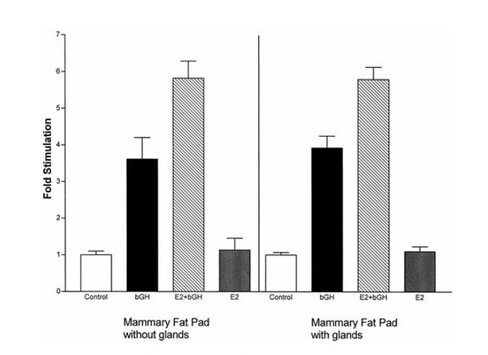
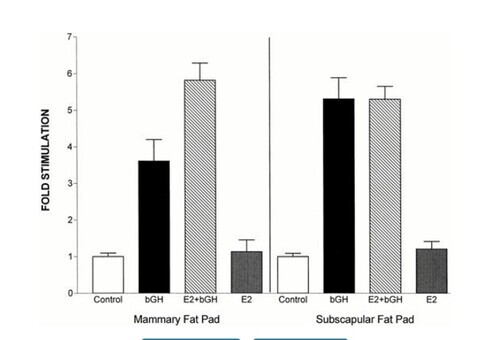
Throwing another ref into the mix for this topic, I found it brief but interesting. Particularly the diagrams with results. "Fold" means multiple of the stimulating effect. It appears that without growth hormone, E2 alone does next to nothing in breast development, fat pad and gland. At least in rodents.
Evidence That the Mammary Fat Pad Mediates the Action of Growth Hormone in Mammary Gland Development
"Recent evidence from our laboratory suggests that GH and insulin-like growth factor I (IGF-I) mediate glandular mammary development together with estrogen. It has also been well established that both stromal and epithelial elements must interact for mammary glandular development to occur. To determine whether the effect of GH is mediated by the stromal or epithelial tissue, we set up the following experiment. Bovine GH (bGH; 100 μg) or BSA (as a control), without or with estradiol (E2), was injected ip into sexually immature female rats that were hypophysectomized and oophorectomized. Mammary glands and subscapular fat pads were removed from the animals. The mammary glands were divided into two parts: a gland-free fat pad and remaining glandular tissue. The end point of bGH activity was induction of IGF-I messenger RNA (mRNA). This was determined quantitatively by solution hybridization and also by RT-PCR. We found that the effects of GH on stimulation of IGF-I mRNA in the gland-free mammary fat pad and the remainder of the mammary gland were similar (3.6- vs. 3.9-fold, respectively; P < 0.001). In both sorts of mammary tissue, bGH was found to synergize with E2 in the induction of IGF-I mRNA (5.8- vs. 5.3-fold; P < 0.001). There was also an increase in IGF-I mRNA in subscapular fat pads in response to 100 μg bGH (5.3-fold; P < 0.001); however, no synergism between bGH and E2 was found. These data indicate that bGH works as well on mammary stromal tissue as on tissue with glands and suggests that GH acts on the stromal compartment of the mammary gland to induce IGF-I mRNA and possibly IGF-I itself, which, in turn, causes differentiation of epithelial ducts into terminal end buds. These data also might explain why mammary epithelium is also able to differentiate in nonmammary fat pads when transplanted there."
to induce IGF-I mRNA and possibly IGF-I itself, which, in turn, causes differentiation of epithelial ducts into terminal end buds.
We don't want differentiation of epithelial ducts into terminal end buds: that means stunting of breast growth before the ducts reached their possible length. Most of breast volume is ducts and stromal tissue between them.
We don't want differentiation of epithelial ducts into terminal end buds: that means stunting of breast growth before the ducts reached their possible length. Most of breast volume is ducts and stromal tissue between them.
Well, no, early terminal end bud formation is of course undesirable. But I don't think IGF-1 does that immediately at physiological levels. It happens with time. But in the mean time, the ducts and fat pad are actually growing, instead of doing nothing with low hGH levels older women have, especially the suppressed hGH activity that happens with oral and high dose parenteral E2.
I also looked into https://www.ncbi.nlm.nih.gov/pmc/articles/PMC3183535/, and recently did some blood work. So, my T is below measurement threshold without supplementation, but I mostly fell fine. I think that a lot of the stuff, including the heart issues I had when I tried 20mg/wk last fall, which I originally thought was attributed to adrenal T suppression via high E2 levels - I think it's more likely to be hGH suppression via high E2. T helped at the time, but it wasn't fixing things completely.
Btw, it appears men and women have quite different daily hGH release profiles in adulthood.
Interesting. What kind of heart issues did you had 20mg/wk Ev?
On Fri, Oct 29, 2021 at 08:08 PM, noface wrote:
I also looked into https://www.ncbi.nlm.nih.gov/pmc/articles/PMC3183535/, and recently did some blood work. So, my T is below measurement threshold without supplementation, but I mostly fell fine. I think that a lot of the stuff, including the heart issues I had when I tried 20mg/wk last fall, which I originally thought was attributed to adrenal T suppression via high E2 levels - I think it's more likely to be hGH suppression via high E2. T helped at the time, but it wasn't fixing things completely.
Btw, it appears men and women have quite different daily hGH release profiles in adulthood.
Interesting. What kind of heart issues did you had 20mg/wk Ev?
It was nasty arrhythmia all day, worsening at night, combined with fatigue, and very low (for me at the time) blood pressure. This started between second and third 20mg weekly EV dose administered. Before that, I was using about 12mg a week. Waiting for the E levels to fizz out for I think more than 2 weeks at that time before resuming injections at a lower dosage did help me start going to bed not being afraid I won't wake up, but I feel like the heart got weakened in some way during that episode and was not immediately recoverable by changing E levels. It took a number of months to get back to a place where I didn't here and there feel the heart flutter in a way that reminded me of how I felt during the episode. I still catch myself feeling like that for a few minutes at a time, but now it happens maybe once every couple of weeks or a month. After that episode, I tested various dosages again soon after, and seemed like 15mg/wk EV was the ceiling of doable for me before I would start a marked worsening in the same direction.
Thanks for the details. As for myself I have been experiencing strong palpitations (premature ventricular contraction) after a few months taking 9mg EEn weekly (or 3x11mg monthly). I had to switch back to transdermal administration (gel). Beside that my blood testosterone level has been not measurable for more than 3 years. I don't know how to link all of this to growth hormone deficiency.
On Fri, Oct 29, 2021 at 08:45 PM, noface wrote:
It was nasty arrhythmia all day, worsening at night, combined with fatigue, and very low (for me at the time) blood pressure. This started between second and third 20mg weekly EV dose administered. Before that, I was using about 12mg a week. Waiting for the E levels to fizz out for I think more than 2 weeks at that time before resuming injections at a lower dosage did help me start going to bed not being afraid I won't wake up, but I feel like the heart got weakened in some way during that episode and was not immediately recoverable by changing E levels. It took a number of months to get back to a place where I didn't here and there feel the heart flutter in a way that reminded me of how I felt during the episode. I still catch myself feeling like that for a few minutes at a time, but now it happens maybe once every couple of weeks or a month. After that episode, I tested various dosages again soon after, and seemed like 15mg/wk EV was the ceiling of doable for me before I would start a marked worsening in the same direction.
Women are in average more flexible than men because estradiol makes ligaments more extensible. Including in the spinal column. Vertebrae pinched a nerve to heart. I had https://en.wikipedia.org/wiki/Premature_heart_beat When I straghten (chest forward, head up and back), the palpitations stop.
That might explain why palpitations are stronger when I am in a lying or sitting position. Maybe I should see an osteopath.
On Fri, Oct 29, 2021 at 09:30 PM, Lena wrote:
Women are in average more flexible than men because estradiol makes ligaments more extensible. Including in the spinal column. Vertebrae pinched a nerve to heart. I had https://en.wikipedia.org/wiki/Premature_heart_beat When I straghten (chest forward, head up and back), the palpitations stop.
I'm probably misstating arrhythmia. I did not go to a caridolgist to get it properly diagnosed at the time because I did not want to risk complications with my dosa freedom until I figured out what's good for me on my own. Risky stuff, I know, but it worked out ok.
I would say my palpitations were also very strong, rather than it being arrhythmia. They were very strong all the time, and erratic only some of the time.
So, probably something similar to what you experienced.
I knew only of adrenal suppression via high E2 at the time. I further investigated other pathways following that, and it appears the link is likely stronger with hGH activity suppression (in high E2 levels, the E2 knocks out external part of hGH receptors in the liver which become GHBP in the blood - bind to hGH and deactivate it, reducing hGH activity and consequently lowering IGF-1 production via more hGH in blood (negative feedback of lower IGF-1 levels) but at lower overall activity levels due to GHBP mopping it up at greater rates). Subjectively this also interfered with feminization (hair, skin issues, breast development stimulation reduction) much like oral E2 also does.
hGH activity reduction can lead to all sorts of issues, for body and brain alike. The review in the article I linked today has a good overview of those, many of which I think I experienced on higher E2 levels.
On Fri, Oct 29, 2021 at 03:19 PM, Mélodie wrote:
Thanks for the details. As for myself I have been experiencing strong palpitations (premature ventricular contraction) after a few months taking 9mg EEn weekly (or 3x11mg monthly). I had to switch back to transdermal administration (gel). Beside that my blood testosterone level has been not measurable for more than 3 years. I don't know how to link all of this to growth hormone deficiency.
On Fri, Oct 29, 2021 at 08:45 PM, noface wrote:
It was nasty arrhythmia all day, worsening at night, combined with fatigue, and very low (for me at the time) blood pressure. This started between
second
and third 20mg weekly EV dose administered. Before that, I was using about 12mg a week. Waiting for the E levels to fizz out for I think more than 2 weeks at that time before resuming injections at a lower dosage did help me start going to bed not being afraid I won't wake up, but I feel like the
heart
got weakened in some way during that episode and was not immediately recoverable by changing E levels. It took a number of months to get back to
a
place where I didn't here and there feel the heart flutter in a way that reminded me of how I felt during the episode. I still catch myself feeling like that for a few minutes at a time, but now it happens maybe once every couple of weeks or a month. After that episode, I tested various dosages again soon after, and seemed like 15mg/wk EV was the ceiling of doable for
me
before I would start a marked worsening in the same direction.
Cool stuff, thank you, I would also wonder a bit about electrolyte balance but probs not mainly that cuz I tried to fix hydration issues(feeling thirsty etc) when I had high E and electrolytes helped some but there was definitely something else going on due to hormones.
Back when I was on like 25 mg per day cypro(fuckeddd lol) and low dose sublingual E with swallowing I had a period of heart flutter for things and a couple instances of passing out too, that hasn't happened in a while, I can get low blood pressure sometimes but it's rare and determined by getting overly dizzy when I stand lol. I think I was getting it more but figured something out about it but can't remember by now lol. I'm doing topical now though. Trying to get down to lower levels/dose still cuz I ramped up pretty high to transition off injections which had probably gotten a bit high again and was figuring it the topical thing, making my own topical stuff etc
On Fri, Oct 29, 2021, 3:40 PM noface <antonysavich@...> wrote:
I'm probably misstating arrhythmia. I did not go to a caridolgist to get it properly diagnosed at the time because I did not want to risk complications with my dosa freedom until I figured out what's good for me on my own. Risky stuff, I know, but it worked out ok.
I would say my palpitations were also very strong, rather than it being arrhythmia. They were very strong all the time, and erratic only some of the time.
So, probably something similar to what you experienced.
I knew only of adrenal suppression via high E2 at the time. I further investigated other pathways following that, and it appears the link is likely stronger with hGH activity suppression (in high E2 levels, the E2 knocks out external part of hGH receptors in the liver which become GHBP in the blood - bind to hGH and deactivate it, reducing hGH activity and consequently lowering IGF-1 production via more hGH in blood (negative feedback of lower IGF-1 levels) but at lower overall activity levels due to GHBP mopping it up at greater rates). Subjectively this also interfered with feminization (hair, skin issues, breast development stimulation reduction) much like oral E2 also does.
hGH activity reduction can lead to all sorts of issues, for body and brain alike. The review in the article I linked today has a good overview of those, many of which I think I experienced on higher E2 levels.
On Fri, Oct 29, 2021 at 03:19 PM, Mélodie wrote:
Thanks for the details. As for myself I have been experiencing strong palpitations (premature ventricular contraction) after a few months
taking 9mg
EEn weekly (or 3x11mg monthly). I had to switch back to transdermal administration (gel). Beside that my blood testosterone level has been
not
measurable for more than 3 years. I don't know how to link all of this to growth hormone deficiency.
On Fri, Oct 29, 2021 at 08:45 PM, noface wrote:
It was nasty arrhythmia all day, worsening at night, combined with
fatigue,
and very low (for me at the time) blood pressure. This started between
second
and third 20mg weekly EV dose administered. Before that, I was using
about
12mg a week. Waiting for the E levels to fizz out for I think more
than 2
weeks at that time before resuming injections at a lower dosage did
help me
start going to bed not being afraid I won't wake up, but I feel like
the
heart
got weakened in some way during that episode and was not immediately recoverable by changing E levels. It took a number of months to get
back to
a
place where I didn't here and there feel the heart flutter in a way
that
reminded me of how I felt during the episode. I still catch myself
feeling
like that for a few minutes at a time, but now it happens maybe once
every
couple of weeks or a month. After that episode, I tested various
dosages
again soon after, and seemed like 15mg/wk EV was the ceiling of doable
for
me
before I would start a marked worsening in the same direction.
Well, no, early terminal end bud formation is of course undesirable.
Well, so, I went to recheck what I read before. I think I had some confusion re. nomenclature and terminal end buds. We want TEB formation, as this is what drives branching and further elongation of the duct tree. Progesterone converts these into alveoli. Did you have confusion about this as well?
The Terminal End Bud: the Little Engine that Could
"The mammary gland is one of the most regenerative organs in the body, with the majority of development occurring postnatally and in the adult mammal. Formation of the ductal tree is orchestrated by a specialized structure called the terminal end bud (TEB). The TEB is responsible for the production of mature cell types leading to the elongation of the subtending duct. The TEB is also the regulatory control point for basement membrane deposition, branching, angiogenesis, and pattern formation. While the hormonal control of TEB growth is well characterized, the local regulatory factors are less well understood. Recent studies of pubertal outgrowth and ductal elongation have yielded surprising details in regards to ongoing processes in the TEB. Here we summarize the current understanding of TEB biology, discuss areas of future study, and discuss the use of the TEB as a model for the study of breast cancer."
On Sun, Oct 24, 2021 at 03:31 PM, Lena wrote:
to induce IGF-I mRNA and possibly IGF-I itself, which, in turn, causes differentiation of epithelial ducts into terminal end buds.
We don't want differentiation of epithelial ducts into terminal end buds: that means stunting of breast growth before the ducts reached their possible length. Most of breast volume is ducts and stromal tissue between them.
to induce IGF-I mRNA and possibly IGF-I itself, which, in turn, causes differentiation of epithelial ducts into terminal end buds.
Endocrinologists love blood tests. An endo said that one of my customers had enlarged tongue, ordered blood tests for IGF-1. Found elevated. The customer didn't have miracle breast growth. Neither before switching to injectable EV (7 mg every 5 days) nor after.